Sevah Research
Falls signals, held up to the light
Ninety-three reused clips: 37 falls first, then 56 everyday activities. The review video, the case explorer, and the paper sit on this page. The numbers below are recorded offline outcomes, not a live deployment.
Offline, reused, and not a certificate
On this reused set the recorded final alert is on for 37 of 37 falls and off for 56 of 56 non-falls. That is not a fresh blind test, not deployment proof, and not a medical certification. The privacy-first architecture in the paper is the intended design, not a measured in-home result. UR14 remains excluded. Missing samples stay missing.
- Falls with a recorded final alert
- 37/37
- Non-falls with a recorded final alert
- 0/56
- What this set is
- Reused offline clips. Falls are shown first. Not fresh blind validation.
Review recording
Raw camera beside what Tara sees
The same 8:51 file the explorer seeks, falls first. Playback uses byte ranges. It is the research review, not a live camera.
Left is the raw camera. Right has no camera pixels: a smoothed 2D skeleton, the center of gravity, a momentum estimate that assumes a 70 kg body, a kinematic skeleton predicted 0.4 seconds ahead, and detected objects.
Figure 7, by cohort
Operating points across evaluated cohorts. Each panel is its own scored set. This figure is not a single pooled accuracy curve, not a fresh blinded validation, and not a resident-day false-alarm certificate.
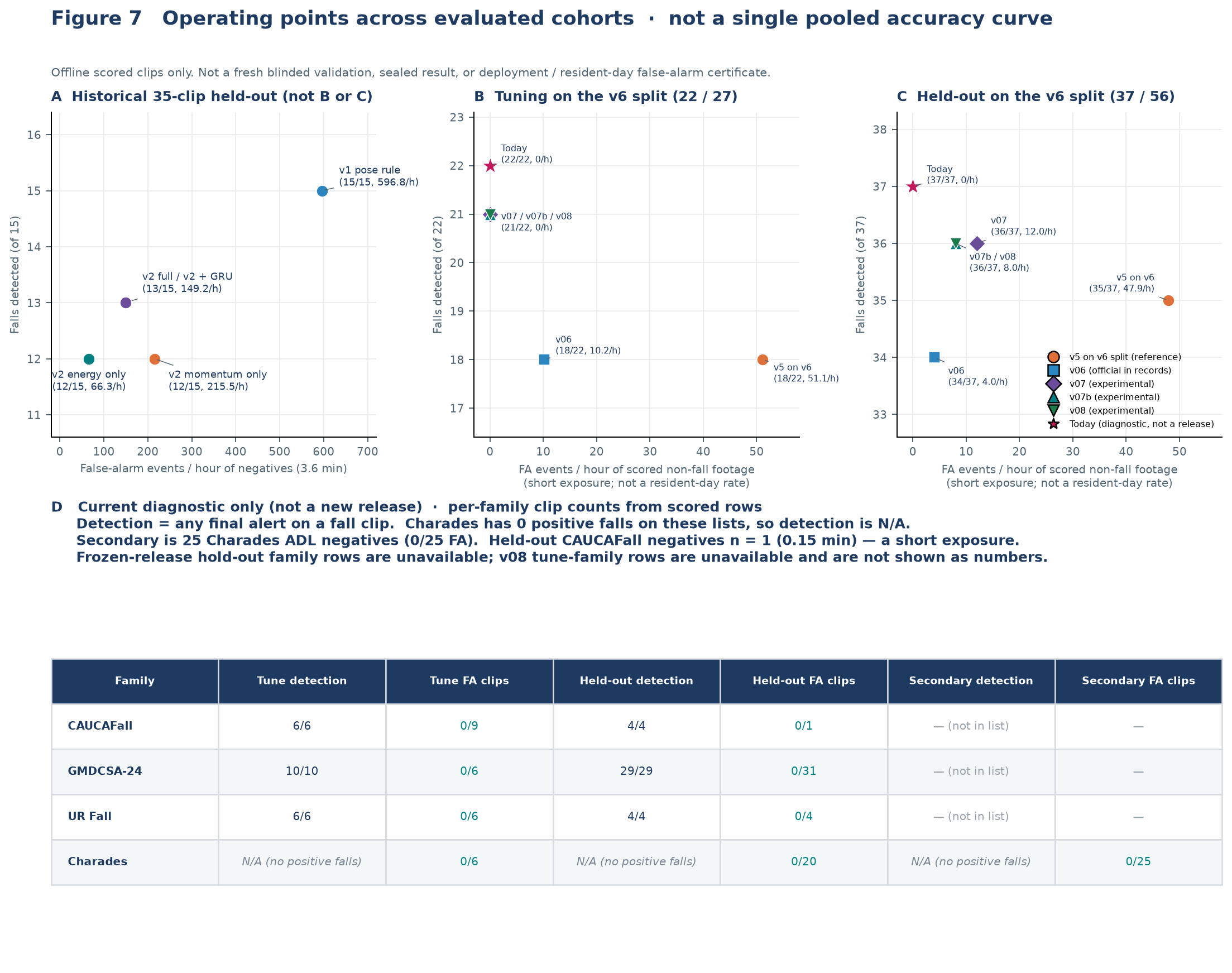
Source: Tara research whitepaper, revision 2026-11-08 r2, Figure 7. Panel C is the held-out v6 split (37 falls / 56 non-falls). Scroll sideways on a narrow screen so the axis labels stay readable.
Open explorer
Every case stays available
The interactive explorer is not behind the form. It plays the same review video and shows cached joint height and vertical velocity, with separate binary alert lanes. Per-line toggles stay for the browser session. Curves are display interpolation of cached image estimates, not calibrated 3D, and gaps are not filled in.
Open the case explorer